

Chinese researchers have outlined a high-stakes strategy for planetary defense that mirrors the premise of disaster films like “Armageddon.” Their proposal involves using nuclear weaponry to neutralize asteroids that pose an existential threat to Earth, a concept the study authors describe as vital for the continued survival of human civilization.
The research arrives amid ongoing concerns from NASA experts, who estimate that as many as 15,000 asteroids—each large enough to level an entire city—remain undetected in our cosmic neighborhood. Because these objects can emerge with warning times as short as a few days or weeks, scientists argue that the ability to rapidly deflect or destroy incoming threats is a necessary component of global security.
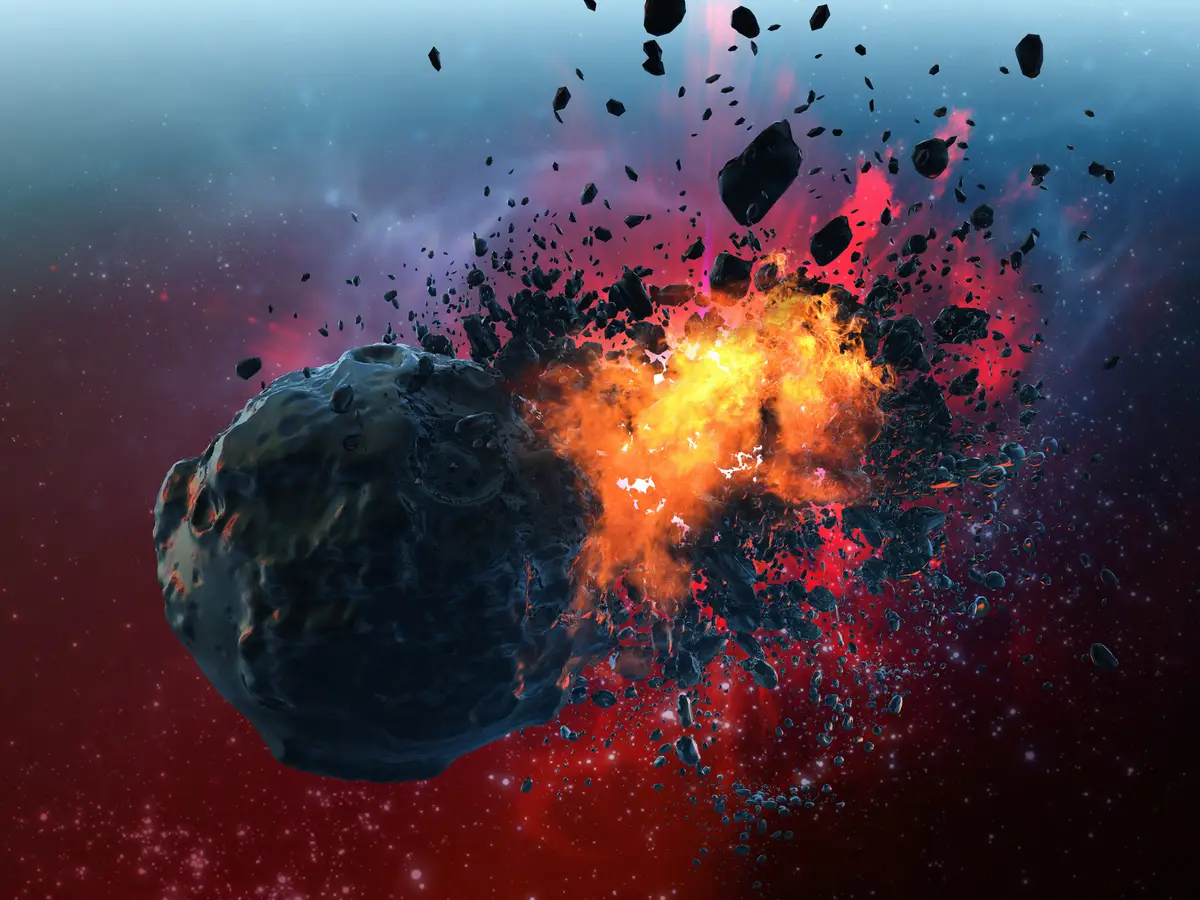
The team behind the study suggests that the most effective approach for extreme cases is to detonate a nuclear device inside the asteroid itself. By burrowing into the object before triggering an explosion, the energy can be used to shatter the asteroid from the inside out, rather than simply attempting to nudge it off course from the outside.
To validate this approach, the researchers conducted extensive computer simulations. They modeled scenarios involving asteroids traveling toward Earth at speeds of approximately six miles per second. Their findings indicated that a 300-kiloton nuclear blast would be sufficient to completely destroy an asteroid measuring 164 feet (50 meters) in diameter. For larger threats, such as an asteroid measuring 328 feet (100 meters) across, the simulation suggested that a 3-megaton explosion would be required to break the object apart.
The study authors emphasize that addressing the risk of near-Earth asteroid (NEA) impacts is a major challenge for international astronautics. They note that historical asteroid impacts have caused mass extinctions and catastrophic environmental shifts, making this a critical area of focus for the global scientific community. The researchers stated, “Carrying out research on NEA defense is an inevitable choice for humanity to protect its survival and development.”
While the simulations provide a mathematical basis for the plan, the transition from theory to reality faces significant logistical hurdles. The most immediate challenge is the requirement for early detection. Without sufficient warning, there is no window of time to launch a mission to intercept the asteroid before it reaches the planet.
Even with a timely discovery, the engineering demands are immense. A successful mission would require the development of a spacecraft capable of transporting both a drilling apparatus and a nuclear payload deep into space. This would necessitate advancements in propulsion, autonomous navigation, and specialized hardware capable of penetrating an asteroid’s surface under extreme conditions.
Looking toward the future, one might speculate on the evolution of this technology. If such a mission were to become a reality, it would likely require a fleet of standardized, pre-built interceptors kept in readiness. These craft might eventually utilize autonomous swarming technology to surround an object, or high-speed kinetic penetrators to create the necessary boreholes for nuclear charges. Such a system would represent a shift from passive observation to an active, space-based defense shield.
Despite the complexities, the researchers maintain that their work holds “profound strategic significance” for humanity’s ability to respond to catastrophic space threats. By detailing the force required to dismantle asteroids of various sizes, the team aims to establish a framework for proactive defense against one of the most unpredictable dangers in the solar system.