
The transition from the canopy to the savannah is perhaps the most defining pivot in the human story. While the shift to bipedalism has long been studied through the lens of skeletal shape, new research led by paleoanthropologists from the University of the Witwatersrand and the University of Southern California offers a more visceral look at how our ancestors actually moved. By examining the internal bone strength of two critical fossil specimens, the team has pinpointed a definitive moment when the human lineage effectively traded the trees for the ground.
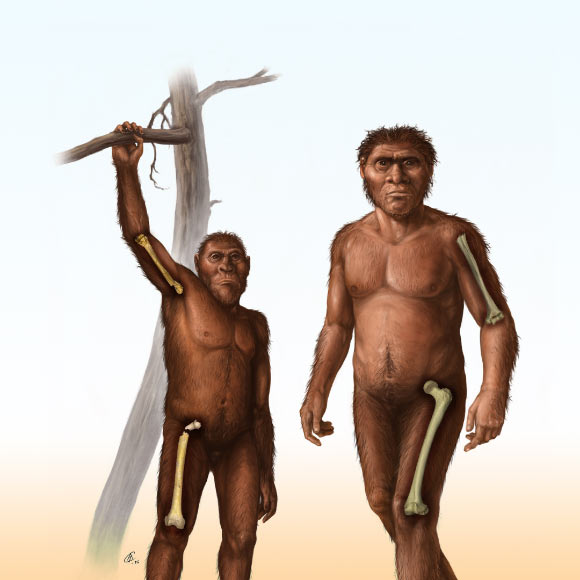
The study, published in *Science Advances*, relies on the principle that bone responds to the physical stresses of a lifetime. By comparing the relative strength of arm and leg bones, researchers can reconstruct an individual’s habitual movement patterns. They analyzed the 3.67-million-year-old “Little Foot” fossil, an *Australopithecus* from South Africa, and a 1.8-million-year-old early *Homo* skeleton from Dmanisi, Georgia.
The findings for “Little Foot” were striking. Despite having lower leg bones that appear somewhat human-like, the overall ratio of its arm strength to thigh strength mirrors that of modern African apes. This suggests that even as *Australopithecus* began experimenting with terrestrial walking, they remained tethered to the trees, maintaining a lifestyle that demanded significant upper-body strength for climbing.
By 1.8 million years ago, however, the evolutionary landscape had changed. The Dmanisi *Homo* specimen exhibited limb strength proportions that fall squarely within the range of modern humans. This suggests that by this point, the transition to obligate, ground-dwelling bipedalism was complete. As lead author Professor Kristian Carlson and his colleagues noted, this represents a major threshold in human evolution, marking the abandonment of arboreal life in favor of a purely terrestrial existence.
This shift invites a deeper meditation on what it means to be human. If our ancestors were still climbing trees millions of years after they had begun to walk on two legs, it suggests that bipedalism was not an overnight “upgrade” but a slow, cautious negotiation with the environment. We often view our legs as tools for efficiency—for covering vast distances—but this study reminds us that for a long time, those legs served a dual purpose, existing alongside the ancient requirement of grasping branches.

Why did this change happen? The researchers suggest that the abandonment of the trees was likely not triggered by the advent of stone tools, as tool production predates this shift by over a million years. Instead, it may have been driven by new foraging strategies and a need to traverse wider ranges. It is also impossible to ignore the timing: this transition coincides with a period of significant brain expansion in the human lineage. While the authors are careful not to claim a direct causal link, the synchronization of these events is profound.
If the brain is the engine of human complexity, perhaps the legs were the necessary infrastructure. By shedding the physical demands of climbing, our ancestors may have freed up energy and resources that allowed for a different kind of development. Moving exclusively on the ground changed our relationship with the horizon, the resources we could reach, and the physical endurance required to survive. It is a quiet, structural revolution—a change in how we carried our own weight that ultimately paved the way for everything we have become.