
Into the Dark: The Man Who Lost Time
In 1962, while the world was looking up at the space race, one young French scientist decided to look down – deep down. Michel Siffre, a bold 23-year-old researcher, embarked on what would become one of the most fascinating self-experiments in scientific history. His laboratory? A pitch-black cave plunging 130 meters beneath the Scarasson mountain. His mission? To understand what happens when humans lose all sense of time.
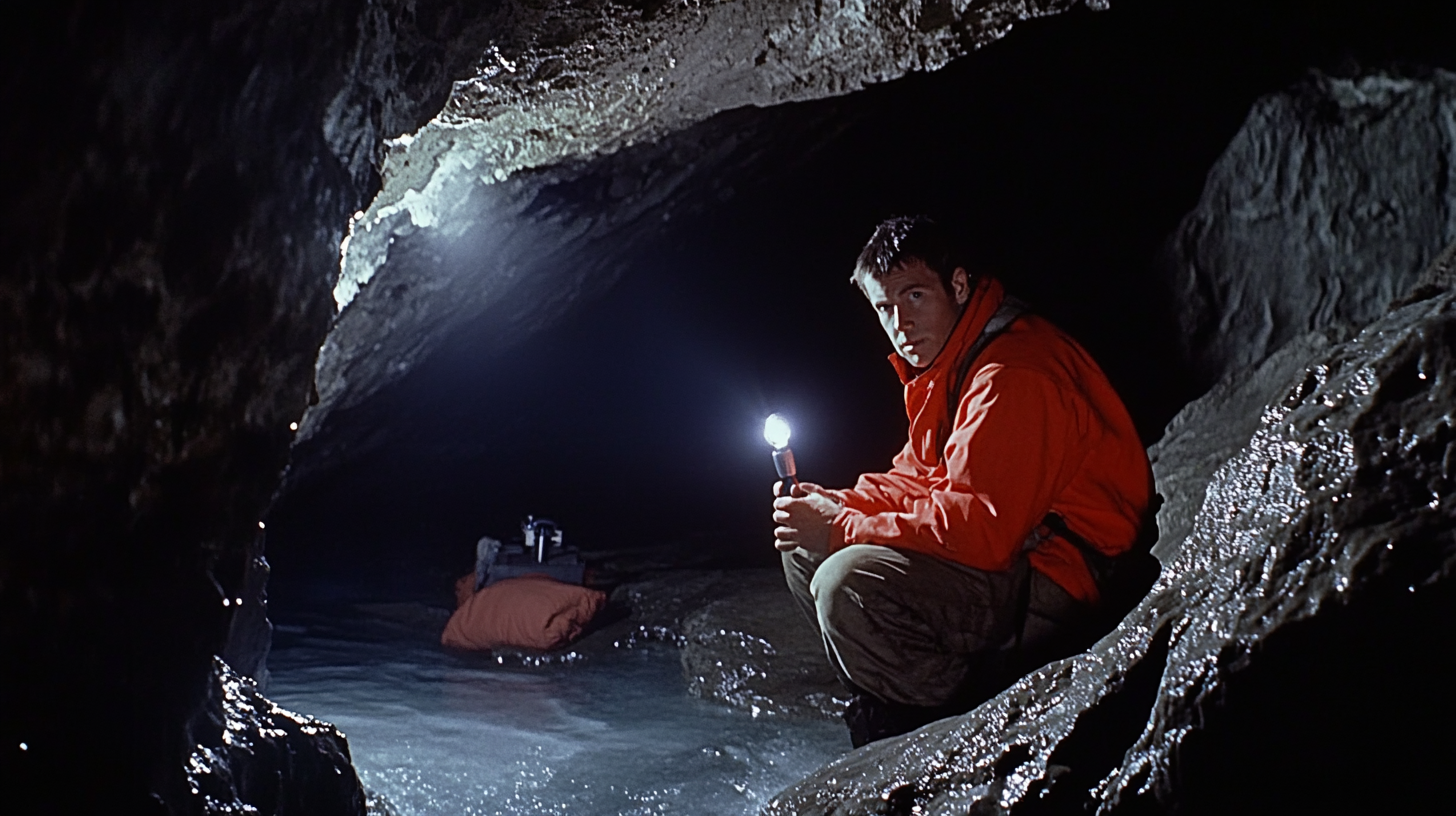
Armed with nothing but a torch, basic supplies, and an extraordinary amount of courage, Siffre set up a modest camp beside a subterranean glacier. The conditions were brutal – near-freezing temperatures, crushing humidity, and a darkness so complete it seemed to have weight. But these harsh conditions were exactly what he needed for his radical experiment.
The rules were simple: no watches, no sunlight, no calendars, no contact with the outside world except for brief radio calls to his research team. He would eat when hungry, sleep when tired, and wake when his body told him to – not when society dictated. His team could record his calls but never initiate contact, ensuring Siffre remained completely isolated from any hints about time passing in the world above.
For 63 long days, Siffre lived like this, conducting regular self-tests and maintaining detailed records. He read books, wrote in his journal, and conducted simple experiments, all while his mind began playing fascinating tricks on him. The most striking discovery came through a simple counting exercise – when he tried counting to 120 at one digit per second, what he thought took two minutes actually took five. His mind was experiencing everything at half speed.
But the most shocking revelation came when his team finally called to end the experiment. Siffre, convinced he still had a month to go, was stunned to learn that his time was up. His psychological clock had completely detached from reality, creating a profound disconnect between his perceived time and actual time.
“When you are surrounded by complete darkness,” Siffre later explained, “your memory loses its grip on time. After just a day or two, you can’t remember what you did hours before. The darkness swallows your sense of chronology.”
What started as a young scientist’s ambitious experiment became the foundation for an entirely new field of study: chronobiology. His findings about human biological rhythms proved so valuable that NASA took notice, using his research to understand how astronauts might handle the timeless void of space.
Siffre, who passed away this year at 85, went on to conduct several more isolation experiments throughout his career, but none quite as groundbreaking as his first descent into timelessness. His work revealed that our bodies harbor internal clocks that run independently of external time – though these internal rhythms can drift dramatically when cut off from the world’s natural cues.
His experiment stands as a testament to human curiosity and endurance, showing just how far one person will go to understand the mysteries of our own minds. And perhaps it offers a lesson: next time someone wishes time would slow down, remind them that there’s always the cave option – just remember to pack a good torch, and leave the watch behind.